Showing posts with label temples. Show all posts

Friday, 26 October 2012

Bali: Sea Temples

Although Indonesia is predominantly Muslim, the main religion in Bali is Hinduism, though it is very much a local variation infused with animist elements. The island is said to have over a thousand temples. This is no exaggeration as there are important temples belonging to the island as a whole, at least three in every village, and most family compounds have their own. In addition, there are little shrines with floral offerings everywhere.

Some of the most important and spectacular of Bali's temples are the sea temples honouring the sea gods. Each sea temple is reputedly visible from the previous one forming a chain around the island. In addition, there are nine directional temples protecting Bali from evil spirits, which are located at auspicious sites from mountainsides to caves and cliff tops.

The 11th century temple Pura Luhur Ulu Watu on the Bukit peninsula in Bali's south is the only temple that is both a sea temple and one of the directional temples. I headed out there last weekend during the three day stopover in Bali I had on my way home and was floored by the beauty of its surroundings.


Pura Luhur Ulu Watu


Gateway flanked by statues of Ganesh, the elephant-headed god


The headland immediately south of Ulu Watu


One of the wildflowers growing near the cliff face. I'm guessing some kind of milkweed, which is an important food source for the larva of some butterflies, particularly the monarch, and there were some spectacular butterflies around.


The headland looking to the north from Ulu Watu


In the distance are a handful of tourists photographing the resident monkeys, but I was intrigued by the forest in the background. At the end of the dry season in the tropics, many flowering trees lose their leaves and burst into flower.  Back home in Brisbane it happens most noticeably with jacarandas and the poincianas.  I don't know what kind of trees these are, but I suspect that in just a few weeks this backdrop could be spectacular.


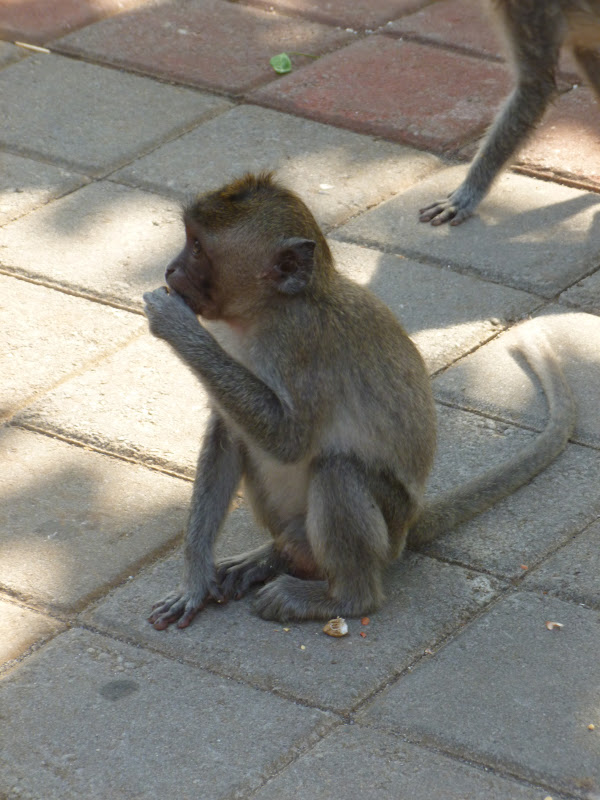
This young macaque was fascinated by the hole in the fabric.


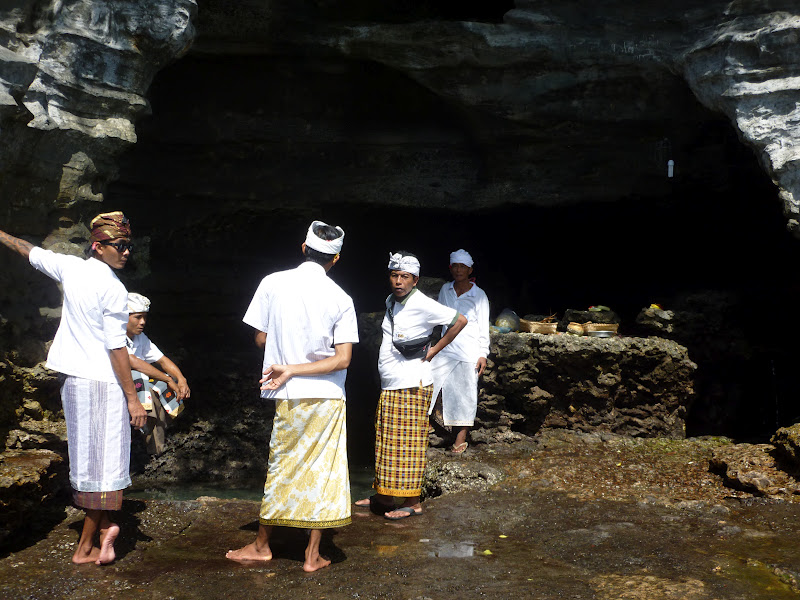
Temple guardians

On my earlier visit in June, I visited what is probably the most well-known and most frequently photographed of the sea temples. Pura Tanah Lot is said to have been established in the 15th century by a travelling monk called Nirartha. It is built on a group of rocks at the end of a headland, which becomes an island as the tide comes in.


The priests give a blessing signified by a few grains of rice on the forehead in return for a small donation.


Then, on the very next headland, yet another temple Pura Batu Bolong. My fear of heights overruled the temptation to cross the land bridge for a closer look.


Whenever I am lucky enough to return to Bali, I would love to visit more of the sea temples.  There are seven important ones, so that's at least five to add to my bucket list.  And then there are the directional temples...

Sunday, 2 September 2012

Ayuthaya - Thailand's ancient capital

Capital of Siam (modern-day Thailand) from 1350 until its destruction by the invading Burmese army in 1767, Ayuthaya is now a UNESCO world heritage-listed site.


Sadly, there are few intact Buddha statues and only a handful of what was once 400 temples have been restored. However, it is still possible to get a real sense of how magnificent Ayuthaya must have been in its prime.

This Buddha head in the tight embrace of a banyan tree is one of the most enduring icons of Ayuthaya.


The corncob-shaped structure in the background is a Khymer-style prasat (residence of a king or god).  Earlier in the day I saw one at Bang Pa-In Palace that had been built by King Chulalongkorn in 1880 and dedicated to King Prasart Thong of  Ayuthaya.


Many of the buildings are on quite a strong lean and would definitely not survive volcanic and seismic activity, such  as Indonesia experiences in Jogya, near the temples of Pranbaran and Borobudur. 


Some of the smaller statues at Wat Na Phra, one of the few temples to survive, because the Burmese army used it as their base.


This green sandstone Buddha in a shrine adjoiing Wat Na Phra Meru is Sri Lankan and 1500 years old.


Making offerings at the entrance of the temple housing the Sri Lankan Buddha.


In the same entry as above, a trio of adenium.


Detail of a niche on the exterior of the main building Wat Na Phra Meru


The reclining Buddha (Budhasaiyart) at Wat Lokayasutha


Lotus offerings to the reclining Buddha


A nearby vegetable patch


More lotus for sale as offerings at the adjoining stalls.


Sunday, 19 August 2012

Colours of Bangkok

When I first started to plan this holiday in Thailand, I imagined I would spend 3 days in Bangkok. In reality it has only been one as I arrived on Day One after 9.00 p.m., and I decided to head out of Bangkok to visit the ruins of the old capital at Ayuthaya on another day.

As I mentioned in my previous post, Jim Thompson's house was high on my list of places to visit, and the photos that follow are from the rest of that day. All have been taken within about an eight block radius from my hotel, either from my morning stroll before breakfast or on a wander on my way back from the canal boat pier after visiting Jim Thompson's, but I think they still manage to capture many of typical sights and colours of Bangkok.

I


Curcuma alismatifolia  'Siam Tulip' - a type of ginger.


There was a lively market along one of the canals at the back of my hotel. It would have been hard to resist the tropical fruits on display if I hadn't already ordered a platter for breakfast (served with a delicious coconut yoghurt).

Mangosteen

Rambutan

Longan


Eggplant and bitter melon

As in my posts of the laneways of Jogyakarta in Indonesia, I love how the locals personalise their homes, whether through use of colour, their potted gardens, wind chimes, and decorative bird cages.

As if the colour scheme wasn't decorative enough, there are great shell wind chimes adorning this house/adjoining houses.


Orchids


A spirit house


More wind chimes and, interestingly, the caged birds here were only of the painted wooden variety.


A canal-side home


and another.


Canal-side eatery


Another casual eating spot with friendly waitress

There were several significant Buddhist temples or wats nearby, including Thepthidaram Worawihan and Ratchanadda, as well as the Golden Mountain.

In the background is Loha Prasat or the 'Metal Palace" with its multiple spires and Buddha relic on the top floor.


The architectural detail on the temple buildings is exquisite and elegant.


Hope you enjoyed my eight block tour; not a huge area, but one that summarises my impressions of Bangkok: colour, mass plantings, exquisite temples, canals and colourful street life.

LinkWithin

Related Posts Plugin for WordPress, Blogger...